
Conventional & Access Testing
Magnetic Particle and Penetrant Testing, supported by rope-access capability for difficult-to-reach areas and structures — so access never decides what gets inspected.
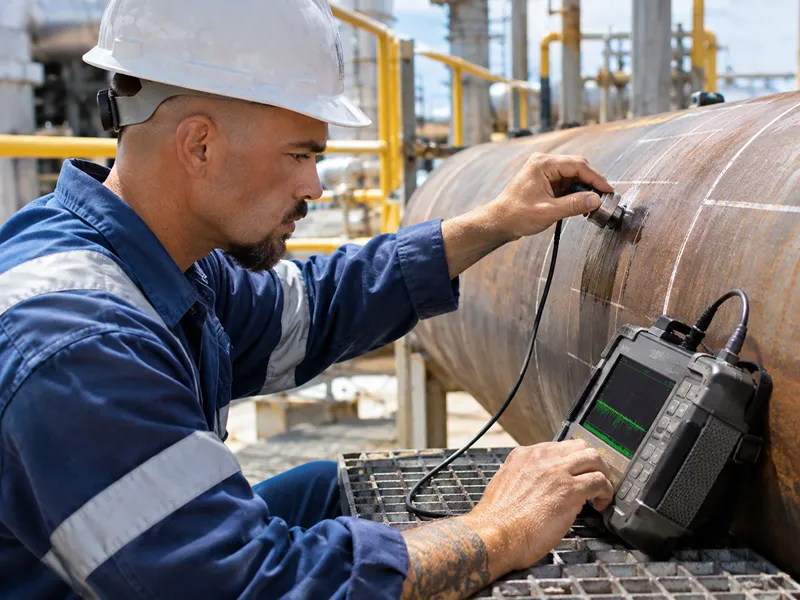
Finding surface cracking, wherever it is.
Most cracking starts at the surface. Magnetic Particle and Penetrant Testing remain the fastest, most sensitive and most cost-effective way to find it — on weld toes, fillet welds, shafts, lifting equipment, nozzles and structural connections. They are simple methods, and they are unforgiving of sloppy technique, so surface preparation, technique selection and lighting are where the result is actually won or lost.
The harder problem is usually getting to the surface in the first place. Flare stacks, columns, elevated structural steel and the outside of tall vessels traditionally mean scaffolding: weeks of lead time, significant cost and a large footprint for what may be a few hours of inspection.
Our rope access capability removes that bottleneck. Technicians who are both qualified inspectors and trained rope access operators reach the work directly, carry out the examination, and leave — with no scaffold to erect, inspect, hire or dismantle.
Surface examination and access capability.
Magnetic Particle Testing (MT)
Surface and slightly subsurface discontinuity detection in ferromagnetic materials. Yoke and prod techniques, dry powder or wet fluorescent, with the magnetising direction set to the orientation of the flaws you expect.
Liquid Penetrant Testing (PT)
Surface-breaking discontinuity detection in non-porous materials, including stainless, aluminium and non-ferrous alloys where MT cannot be used. Visible dye and fluorescent systems, solvent-removable or water-washable.
Visual Testing (VT)
Structured, documented visual examination — the first and often most informative step. Weld profile, mechanical damage, coating condition, external corrosion and the evidence that tells you where to look harder.
Rope access inspection
Two-rope working to reach elevated, confined and awkward structures without scaffolding. The inspector is the climber, so there is no handover between access crew and inspection crew.
Hardness & replication support
In-situ hardness testing to support post-weld heat treatment verification and material confirmation, where the scope calls for it.
Weld and fabrication surveillance
Surface examination at hold points during fabrication, repair and construction, with results issued as the work proceeds rather than after it.
Inspection at height, without the scaffold bill.
Scaffolding frequently costs more than the inspection it supports and takes longer to erect than the examination takes to complete. For discrete inspection scopes on elevated structures, rope access is usually the faster and cheaper route — and often the only practical one during a live operating period.
Because our technicians hold both the inspection qualification and the rope access training, there is no split between an access contractor and an inspection contractor, and no waiting for one to finish before the other starts.
- No scaffold lead time — mobilise in days rather than weeks
- Significantly lower access cost on short-duration inspection
- Minimal footprint at grade; surrounding work continues
- Fast repositioning across a structure in a single shift
- Inspection and access carried out by the same qualified person
- Suited to flare stacks, columns, towers and structural steel
- Practical for unplanned outages and emergency assessment
- Reduced disruption to live operating areas
What we examine.
- Weld toes, fillet welds and structural connections
- Pressure vessel nozzles, seams and attachment welds
- Flare stacks, columns and elevated vessels
- Lifting equipment, padeyes and rigging points
- Shafts, couplings, gears and rotating components
- Storage tank shell and roof welds
- Crane structures, booms and load-bearing steel
- Repair welds and post-weld verification
Worked to the code that governs your asset.
Surface examination is carried out and reported to the article and acceptance criteria that govern the component.
What you receive.
Every job closes with documentation your engineering, reliability and integrity teams can file, audit and act on.
- Technique sheet stating method, materials and lighting used
- Calibration and system performance verification records
- Indication location, type, length and orientation
- Photographic record of reportable indications
- Accept / reject assessment against the governing criteria
- Rope access plan and rescue plan where applicable
- Repair recommendations and post-repair re-examination
- Signed report in your document control format
Structure you cannot easily reach?
Tell us what needs examining and how high it is — we'll tell you whether rope access beats scaffolding on your scope.